Tokyo Ghost - We Choose What’s Around
Welcome back to the Compendium! Thank you for following us thus far, and as for today’s entry I wanted to cover a little story that I find to be especially poignant these days. So without further ado, what’s the story behind Tokyo Ghost?
1: Story Behind the Story ( 4 minute read )
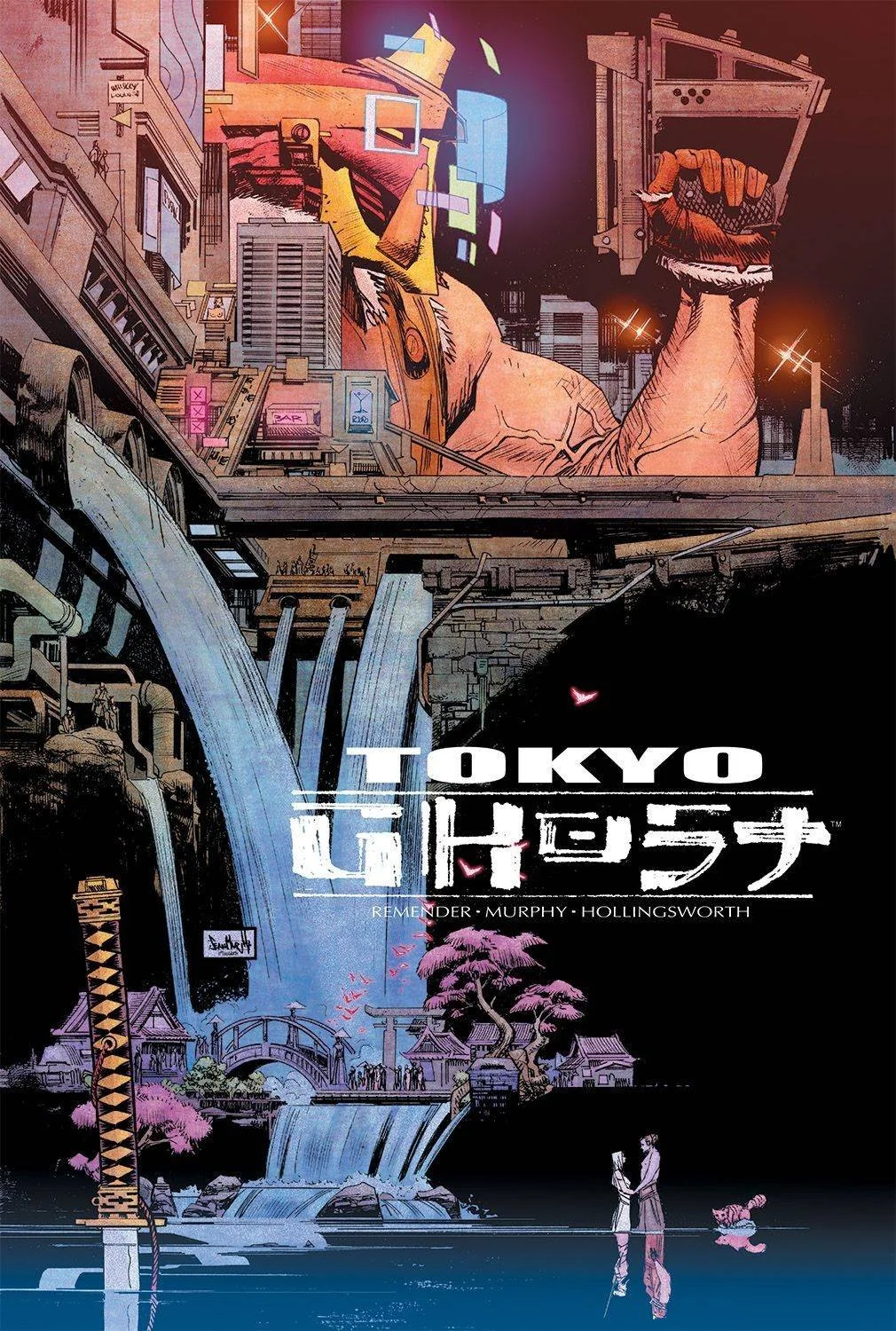
Tokyo Ghost is a story that, like most sci-fi, paints a picture of an ‘ever so cruel, and dystopian future’.
Though from some perspectives I could understand why one might think it's rather ‘vanilla’ in terms of its take on sci-fi, I believe that what it is saying is uncomfortably realistic just even one decade after its initial release.
Through its obscene and oftentimes absurdist representation of how we as a society have chosen to adapt technology into our daily lives.
What Tokyo Ghost paints is in a lot of ways just what you’d expect from something that chooses to align itself with the ‘cyberpunk’ genre these days.
Its got a giant metropolis with streets rife with the type of ultra violent crime that requires at least some level of creativity to keep your sensations firing.
Its got big corporations foaming at the mouth to extort and use the public for their capitalistic gain.
Its got it all, all the big ‘cyberpunk tropes and themes’, if you will.
But what I find to be the source of this stories impact is in its thematic focus, and in its length.
Tokyo Ghost has all the trimmings of your typical cyberpunk story, but with the main ‘statement theme’ being the concept of attention.
Specifically how we as a society have chosen to adapt technology in a way that has eroded our attention spans.
You mentioned that Debbie and her father are “straightedge” In relation to technology, and the term brings up the drug-free lifestyle philosophy of Ian MacKaye. Is that casting technology as a drug, at least in the world of Tokyo Ghost?
RR: I think in the world of Tokyo Ghost and out. I’ve read numerous articles that talk about the endorphin rush that one gets when checking the internet, or when your phone ding-dongs and lets you know that somebody posted something on Facebook or Tumblr or Twitter or whatever the thing is. It gives the same endorphin rush as before you pull the lever on a slot machine. It has the addictive qualities, but we haven’t begun to address it as a society yet, and I think that we will. In China, it got so bad that they have de-programming facilities now, where they basically have to go in and they put kids through a rehabilitation because they see the real world as artificial, because they’ve spent so much time online and in these virtual realities on games, and all of their social life is digital. This is where we’re headed, I think.
- Rick Remender, with James Lovett, From Comicbook.com
From Pencil, to Paper. From Story, to History
Software specifically designed to work in tandem with our biology to hijack our focus, creating new ‘tech addicts’ who cant even sustain their own basic bodily functions.
This is the world of Tokyo Ghost.
They strap into chairs that provide all forms of sensation to go with all the ‘content’ or ‘media’ that is being consumed.
Catheters allow the consumer to ‘relieve’ themselves, or otherwise excrete what waste they must.
Bags of water must be refilled daily to keep the users hydrated and alive, and in the world of ‘Tokyo Ghost’ this is usually done by whoever is imparted the position of ‘caretaker’.
Which leads to the second part of Tokyo Ghost’s ‘statement’.
How does this full surrendering of ones self to the ‘content’ effect those around?
Those we ‘love’?
The way that Rick Remender and Sean Murphy decided to express this is by applying similar dynamics and behaviors to that of a real drug addicts relationship towards their ‘loved ones’.
And in the case of Led and Debbie, the lead characters of Tokyo Ghost, they decided to have her play the role of the ‘forever lover’ as well as the ‘unintentional enabler’.
‘As we bounce between these two cities and get a look at these two different things, we will use that to examine this character, Led Dent, who’s addicted to technology to the point of no longer being cognitive of what he does everyday, which is pretty awful. His long time girlfriend, Debbie Decay, who plays basically the Jiminy Cricket on his shoulder, trying to direct him to making the right decisions and doing the right things, all the while seeing him receded and disappearing into nothing. You’ll see just how intense the technological addiction can be, and how much worse I think and Sean thinks it’s going to get, coupled with the inevitable co-dependence of the person who loves someone who’s addicted to tech and lost in it and how far she’ll go to save and regain the man she loves.” - Rick Remender, with Comic Vine.
This story is only 10 rather short volumes long.
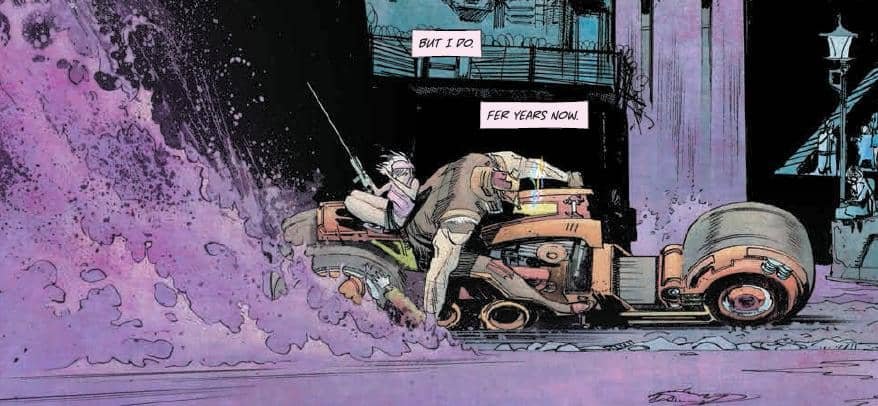
It doesn’t overstay its welcome, and this only makes its story, statement, artwork, and characters stick with you that much more.
So the big question is, how was the process of making something like this?
The Big Reason
So here it is.
They had a clear goal.
From the earliest meetings Rick had known what he wanted to speak on.
”We started developing the book a couple of years ago, and one of the things that we both wanted to explore was the depth that society might find their technological addictions reaching, in that we were basically discussing at length the inability to go out to dinner with people and not have everyone on their cell phones, checking every five or ten minutes, our own addictions to checking the computer, and the phone, and the iPad, and the Kindle, and basically, at this point, there’s a screen or a monitor in every inch of my life.” - Rick Remender, with James Lovett, from Comicbook.com
Past that, the effort that was put into Tokyo Ghost was collaborative and loose.
Rick, Sean Murphy, and the artist Matt Hollingsworth made sure the creative environment was a product of passion, and that whatever they produced was the product of them having fun.
“Being able to do the kind of comic book that isn’t really done anymore. Like I said, it’s a kind of love letter to Blade Runner, Judge Dredd, Akira, RoboCop, that have that dystopic apocalyptic future that isn’t super unreasonable at this point and still have a good dollop of humor and makes fun of a lot stuff and makes fun of itself. Just to be able to go nuts and see somebody like Sean and Matt bring it all together the way that they have.” - Rick Remender, with Comic Vine.
They approached this ‘mature’ or ‘topically strong’ concept, and approached it with a joint childlike innocence and overall playful energy.
This can only be done when you surround yourself with the proper people to collaborate with.
The people the both inspire and push you.
The people who you can get excited alongside and workshop concepts with.
Those who truly care about their art, and their craft.
So take Rick, Sean, and Matt’s story.
Take their world of Tokyo Ghost, and take the lessons they illustrate with Debbie and Led.
And always consider,
that who, and what, we choose to surround ourselves with, really matters.
2: My Two Cents
I. Begin making a simple list of ‘statements’ you want to make with your art. You don’t have to specifically write them down with intent to use it, but this exercise is helpful for generating ideas, but most all generating drive and forward momentum.
II. Even the most ‘serious’ and ‘important’ statements you want to convey with your art should be approached with a level of innocent intrigue.
3: Quotes From Others
I. “We wanted to take things that already exist and just push them far enough that people could see how ridiculous—and dangerous—they might become.”
-Rick Remender
II. “If it feels over-the-top, that’s the point. We’re just taking what already exists and turning the volume way up.”
-Sean Murphy
III. “We wanted Los Angeles to feel like it was choking on media… like every surface is trying to grab your attention.”
-Sean Murphy
Thanks for reading!