Satoshi Kon’s ‘Opus’ - A Model Creative
Greetings and welcome back to the Compendium!
While I continue with my research for Death Stranding 2, I figure this is a good time to cover a little story that I find oh so interesting. So anyway, without further ado.
What’s the story behind Satoshi Kon’s Opus?
1: Story Behind the Story ( 4 minute read )
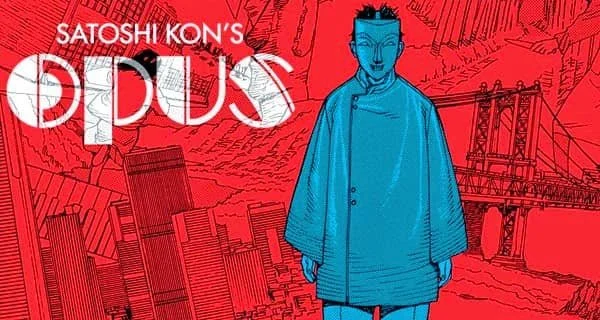
Satoshi Kon is a Japanese film director best known for his films Perfect Blue, Paprika, and Tokyo Godfathers.
He had a fascination with dreams, and that fascination poured into every facet of his animation style leading to some of the most reality bending works of animation I’ve ever seen.
His approach towards scene changes in particular was what added to this surrealist type of feeling all his works had.
He would utilize match cuts as well as dynamic spatial transitions, all with a healthy dose of blurring the lines between reality and a dreamlike fantasy state to evoke a very seamless and fluid editing style.
This style of editing would pair right with his surrealist style of storytelling, and amount to works that have gone on to awe and inspire many.
For instance is it weren’t for his film ‘Paprika’, Christopher Nolan wouldn’t have gotten the idea for a ‘dream hopping heist’ that would go on to become Inception. Not to mention how much Paprika influenced the overall visual style of Inception.
Hell even Darren Aronofsky cites ‘Perfect Blue’ as being ‘heavily inspirational’ to his filming and writing of both ‘Black Swan’ and ‘Requiem for a Dream’.
So while many know a talk about Satoshi Kon’s films, I not too sure how many people know his history working in Manga.
You see Satoshi wanted to become an animator from a very young age so he studied towards that aspiration, and by the time he had graduated college he had already had his debut as a manga artist as well as securing a position as assistant to none other than Kastuhiro Otomo best known for ‘Akira’.
He actually was even able to work on the Akira manga as an uncredited artist, as well as assistant to Otomo.
He had cited many times how much of an impact his time working under Otomo had on himself as an artist, and in particular how it really prepared him to move on from manga to begin working in full time animation.
Now right around this transitionary time moving from manga to anime, Satoshi would work on a little manga series called ‘Seraphim: Wings of 266,613,336’ that he made in collaboration with a fellow manga artist Mamoru Oshii, best known for creating ‘Ghost in the Shell’.
Seraphim would go for a number of issues until Kon and Oshii would begin to run into differences of opinion of where the story should go, and then would begin an indefinite hiatus which would leave the story unfinished up to today.
Satoshi then went on to work on another small serialized manga he titled ‘Opus’.
Opus is a story about a mangaka named Chikara Nagai who doesn’t know how to finish his story titled ‘Resonance’.
Opus begins with the final climatic battle within Resonance between its protagonist a telepathic investigator named Satoko, and the leader of the ‘Nameless Faith’ cult, the Masque.
The mangaka is planning to kill of a main character in this final battle of ‘Resonance’ only to have that character literally climb out of the page and pull Nagai into the world of ‘Resonance’.
And thus begins Satoshi Kon’s signature blurring of reality.
It’s a story that delves into the concepts regarding an artists relationship to their art, how we as humans carry the psychological burdens of trauma, and the overarching themes of the relationship between creator and creation.
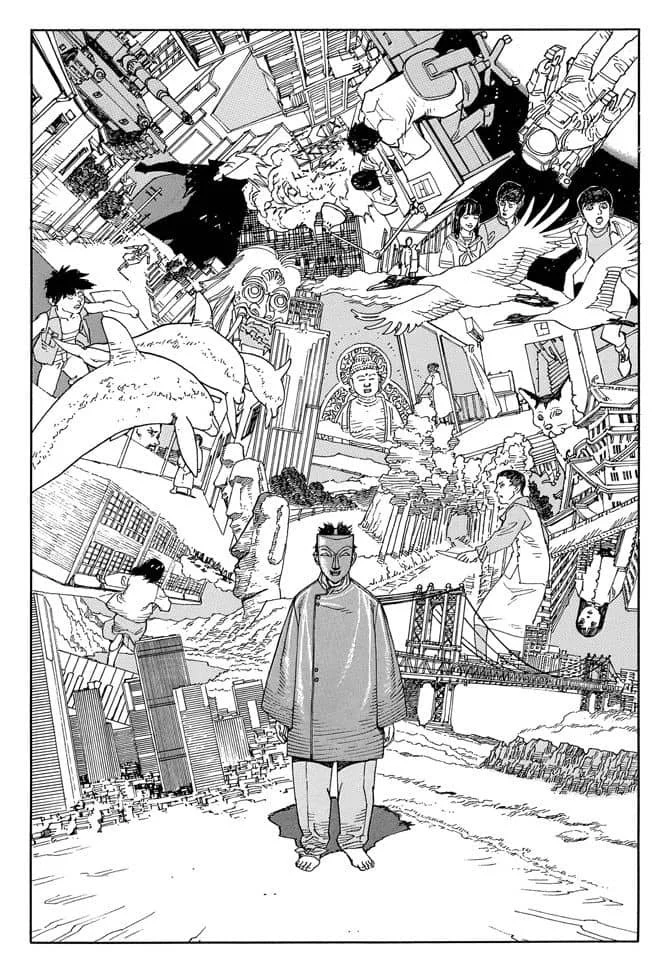
Overall the story is a fun and exciting little adventure to go on, it’s not the most groundbreaking story I’ve ever read, nor is it the worst, but what I can definitely say it that it is definitely from the mind of Satoshi Kon.
Now you may be wondering why I’m even covering this story.
I mean why would I, if it's kind of lukewarm is some regards?
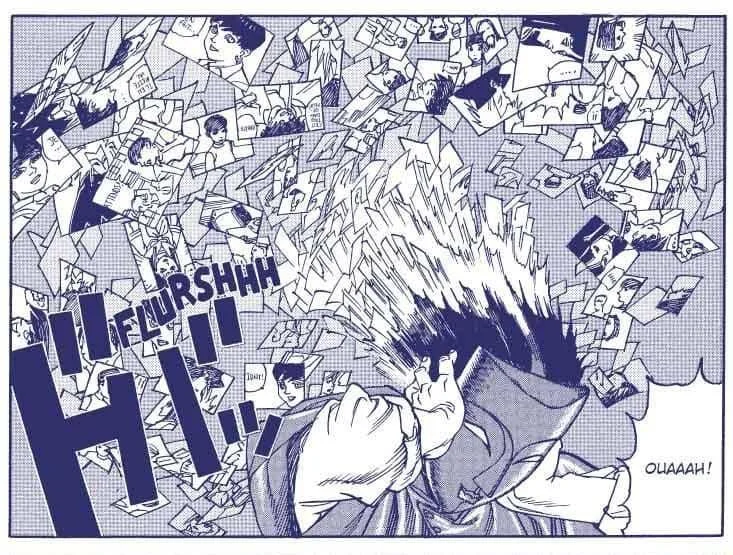
Well the reason why is because I genuinely think there's plenty to chew on with Opus, specifically in terms of Kon’s intuitive and creative usage of the physical paper medium to subvert the typical navigation of the panels.
Satoshi really does have a knack for thinking way outside the box of the medium he’s working in, and Opus is chock full of ideas that can be pulled and iterated upon.
But the main reason why I’m covering Opus is because it was yet another story in which Kon was just not able to finish for one reason or another.
You see Opus ran as a serialized comic within the magazine called ‘Comic Guys’, and was pretty popular within the magazine, however the magazine would end up cancelled while Opus was still in serialization.
Opus, alongside the manga he did alongside Mamoru Oshii, were just two of a number of ‘collapsed projects’ that Satoshi faced around this time.
Having two of your works forced to end in an unfinished state would make any artist stop and think about the actual purpose behind this path of ‘art’, but for Satoshi he decided to keep moving forward.
He used it as a time to move on from what was frustrating him within manga, to move on from instability that came with working on manga, and he did it to finally explore the reality blurring possibilities that came with animation.
Satoshi directed four feature films, a short anime series, and a short film before he went on to begin working his final piece.
He began working on what would be known as ‘Dreaming Machine’, but would not be able to see the project through due to has sudden diagnosis and rapid decline from pancreatic cancer.
I know this seems like an odd direction to take this entry, but the picture I’m trying to illustrate is one of a man who had a desire to create, who had worked hard towards this desire, and who eventually achieved it.
He kept moving forward, and kept on creating.
There’s just seemingly a lot of life that tried to hold him back, and that’s not what made him special, what made him special is that he still created in spite of what life threw at him.
I think most all of us can attest to how life throws its punches, and for a lot of us creatives it can break us down to the point of not expressing ourselves through our craft.
I could truly go on, and on about Satoshi Kon and his works, and none of what i have to say would really do his works any justice.
Please watch his films, and read his stories.
But I just wanted to go over this story as a reminder, and an encouragement to you all to keep on creating.
I think Satoshi Kon and the creative life he lived is a prime example of the creative process; The creative journey.
2: Creative Prompts From Us (ex. Write a short story, a poem, a song, or draw a quick illustration of these! Let your imagination run free.)
I. Focus on maintaining your forward momentum. It is crucial to completing your works.
II. Even if a project doesn’t come out a intended learn what you can, and move on to the next project. Don’t stop creating!
3: Inspirational Quotes From Satoshi Kon
I. “I’m not interested in depicting dreams as dreams. I’m interested in depicting the ambiguity between dream and reality.”
II. “Editing is not just about cutting — it’s about guiding the viewer through layers of reality.”
III. “If my works inspire someone else’s imagination, that makes me happy.”
Thank you for reading!