feb 5th 1-2-3: Old vs New - Super Mario Sunshine
Hello, and welcome back to the Compendium!!
Boy oh boy does it feel good to be back writing for you few weary eyes who have followed us this far.
Thank you for your attention once a week, and for today I’ll be taking a little detour before I finish covering the works of Hideo Kojima to talk about a classic little platformer I had the pleasure to going back to over the holidays.
So without further ado, What’s the story behind Super Mario Sunshine?
1: The Story Behind The Story ( 4 minute read )
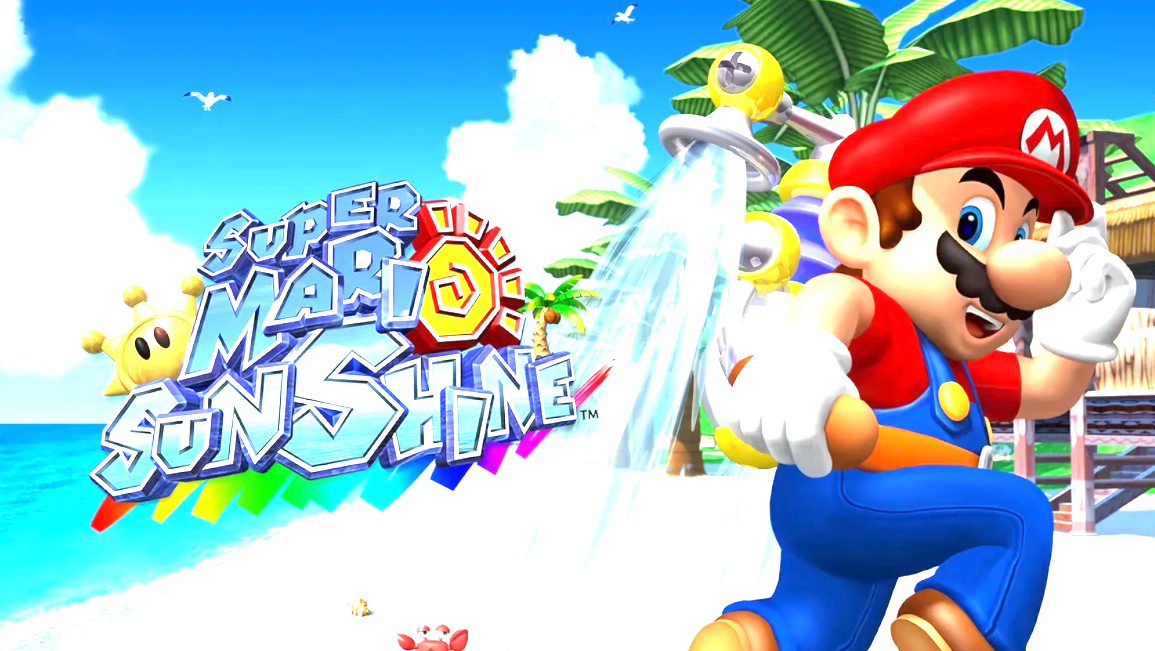
After the dawn of the third dimension in the video game industry just a generation before, most of the big name devs looked to the sixth generation to raise the bar in terms of fidelity, to deepen immersion, and to refine 3D camera controls.
Nintendo was one of the leading names in the industry after their moderate commercial success, and massive critical success with the Nintendo 64.
With their next console the wanted to push even further with many of the concepts they had already brought over into 3D; they wanted to refine their franchises, while also taking a level of calculated risk to push the medium.
And when it came to their golden boy, the famed Italian plumber, they decided to split their team by tenure.
This was so they could have the older more experienced developers on the team focus on maintaining what Mario had already established himself to be, while the younger more creatively ready for risk members of the team could focus on breathing new life into the Mario IP to expand it in some newer exciting directions.
The old guard was mainly led by series veterans Shigeru Miyamoto, and Takashi Tezuka, who worked on Mario Sunshine as executive producers.
While the new guard was led by Yoshiaki Koizumi who was given the opportunity to co-direct Mario Sunshine alongside Kenta Usui.
Countless times over the course of the development the team would bring their new exciting ideas over to the veteran devs, only to be met with utmost concern for the directions they were suggesting.
Often times these ‘concerning ideas’ would become an almost controversial talking point for some of the veteran devs who felt like the younger devs might not understand what Mario had already established himself to be.
However this notion would quickly be broken down when the young Koizumi first showed Miyamoto his ‘gimmick’ idea for this title.
Koizumi, from the moment he was given the role as director of this title had pictured Mario with some sort of water pistol, citing that the Gamecube's triggers had often reminded him of the feeling of pulling the trigger of a water pistol; and when he showed Miyamoto he was met with only a look of worry and concern.
This led to discussions surrounding the idea of Mario using forms of tools within his games with Shigeru ultimately and apprehensively allowing FLUDD via a joking remark “It was ok for Luigi, so…”, in reference to Mario's lugubrious brother using the Poltergust tool in his own title.
This experience created a new path for the two sides of the development team during Mario Sunshine's Development cycle.
It was a path of the young refining their own take on this medium, while the veteran devs were there for guidance, support, and most of all to pass on their craft to a new generation.
The New Dynamic
Typically the younger devs would show some new ‘risky’ direction to take a particular aspect of the game, and the veteran devs would allow them to go in that direction, but only if they followed particular disciplines set by the old guard.
For instance when it came to the actual implementation of FLUDD one of the first things Miyamoto had noticed was how much the idea of this tool was changing how the developers thought about Mario's actual moveset, and so he gave them the particular discipline of maintaining the exact same moveset Mario had in Mario 64.
This led the team to realize that the most important thing for this game was its feel. thus making the start of this team following the motto “the game needs to feel good, before any ideas could be implemented”.
A developmental ideology you still see within Nintendo today, with their ‘putting play first’ approach to development.
Heck, even the general design of the FLUDD had gone through this same process between the old and new guard.
When FLUDD was first shown and accepted as the direction they were going to head , the new guard had initially imagined FLUDD as a pair of water pistols.
But the old guard really didn’t like that, as it went against the precedent Nintendo had created for itself with Mario and depicting him with anything like or associated with firearms.
So they gave the design teams the discipline to be playful with their depiction of this ‘water based tool’ for Mario.
Specifically they gave them directions to be as playful and creative as possible with it, while straying away from being too sci-fi or militaristic with its design.
Another example of this dynamic the old and new guard had built over the coarse of development is the overall style of Mario Sunshine.
Mario Sunshine is the only Mario title to have fully voiced cutscenes, and it’s also the first title in the Mario IP that began to ‘cute-ify’ the overall aesthetic and design of many of the supporting cast of friends and foes of Mario.
Miyamoto was immediately averse to the idea of fully voiced cutscenes, and alongside some early designs of characters being, in his own opinion, ‘too cute’ for Mario he had a conversation with Koizumi and laid out some rules.
He had explained to Koizumi that Mario must sit in the center in between being ‘cool’ and ‘cute’.
He explained that design wise, if Mario is too cute, it makes him an odd character being that he is a middle aged Italian plumber.
On the other hand if Mario is just super badass, he begins to loose his relatability and begins to become a figure fans look up to, rather than feel kindred with.
Over the course of Sunshine’s development the Old Guard vs New Guard mentality had eroded, and all that was left was something far more valuable than the sum of its parts.
it had become much more reminiscent of a Mentor to Student dynamic, where the Veteran devs could refine and pass on what they had learned through their lives as artists within this medium.
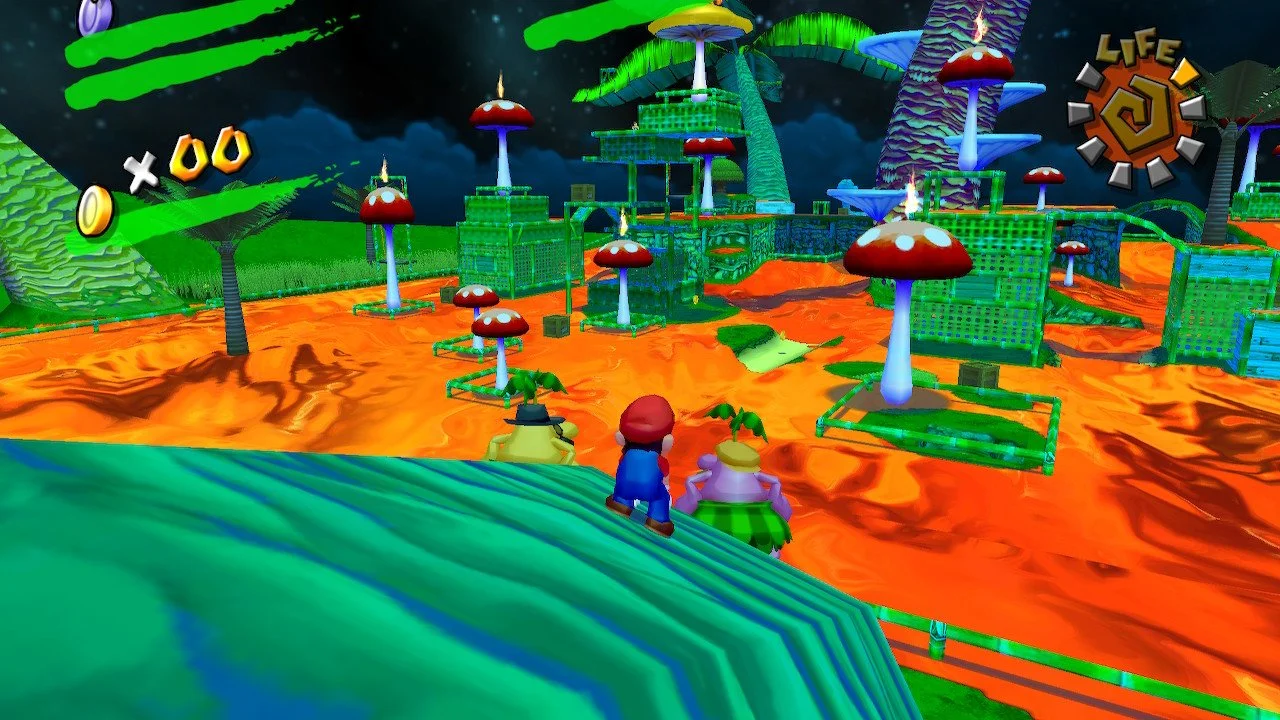
The Mentor/Student Collaboration
Mario Sunshine is a somewhat controversial title for fans.
Much more loved today than in its initial release.
The work and innovation the ‘New Guard’ of Sunshine's development had done was recognized by Nintendo and most of the team was moved to a then newly formed Nintendo EAD Tokyo development studio.
They have since gone on to create Mario Galaxy 1 & 2, both Zelda OoT/Majora Mask 3D, Mario Odyssey, and many more.
Currently this team has branched off again with significant partition of the team most recently developing and releasing Donkey Kong Bananza.
A sign that I take to be clear that what was passed on to them during the development of Sunshine, is again being passed on to another generation of developers.
It’s a special form of collaboration, the Mentor/Student collaboration.
As a teacher, teaches, he is if refining his internal knowledge of a particular subject.
As a Student submits to the teachings of his mentor, he begins to absorb aspects of the experiences the Mentor has gone through.
It’s a two way road.
For a Student to refine his craft, he much find a fitting teacher/mentor to progress.
For a Mentor to refine his craft, he must find a student fitting to submit to his teachings, and he must be ready to bare the heat of an inexperienced unresolved pupil.
They are but two travelers, on two different parts of their respective journeys as artists.
To individually progress, they both must collaborate and cooperate with one another.
2: Creative Prompts From Us (ex. Write a short story, a poem, a song, or draw a quick illustration of these! Let your imagination run free.)
I. To create great art we must surround ourselves with likeminded individuals who will encourage and support us towards our creative goals. Being surrounded by ‘creative skeptics’ is an exhausting endeavor, that will slowly but surely snuff out that little creative flare that drives you.
II. If something you create just feels right, think about why it feels right. But don’t concern yourself so much with why it feels the way it does, as you just might find that in your endeavor to get to know it better, you actually slowly strangled the life out of it. E.I. Don’t dissect the frog. By dissecting the frog, sure you’ll know more about it, but ultimately, the frog will also invariably be dead.
3: Quotes From the Team
I. “When I first heard the idea of Mario carrying something on his back and shooting water, I was worried about whether it still felt like Mario.”
-Shigeru Miyamoto
II. “We wanted to challenge Mario. Miyamoto-san wanted to protect Mario. That tension created the game.”
-Yoshiaki Koizumi
III. “Mario stands between cool and cute. If he becomes too cool, he’s no longer relatable. If he becomes too cute, he stops feeling real.”
-Shigeru Miyamoto
Thank you so much for reading!