Jan 29th 1-2-3: Labyrinth - When you’re ahead of your time.
Hi there!!
It’s been a few weeks since our last newsletter entry. It has been a fun time over here as we adjust to personal, business, and world changes.
We are grateful you are still with us, and are looking forward to a wonderful 2026!
For this year’s first entry, I want to talk about a movie that I watched a ton as a child, that I watched a ton with my own children over the Holiday break.
I am talking about Jim Henson’s, Labyrinth.
So what’s the story behind Labyrinth?
1: The Story Behind The Story ( 4 minute read )
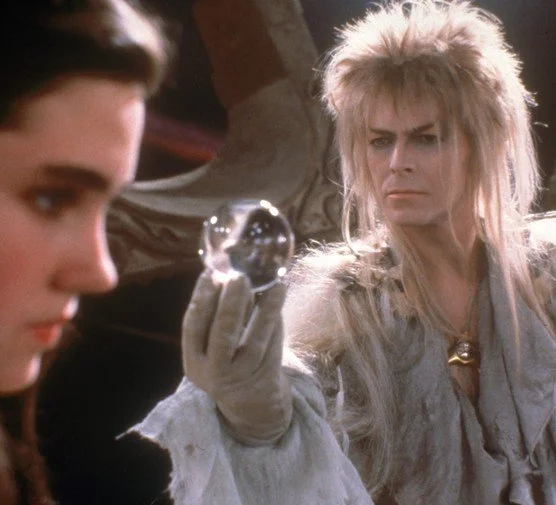
So you found yourself pigeonholed as “children’s entertainment.”
Now what?
Well, you can always do what Jim Henson did.
He made what he wanted, and what he wanted, was dark.
By the time it was the early 1980’s, Jim Henson had become a creative powerhouse due to the mainstream success of The Muppets TV Show as well as movies and Sesame Street.
Everyone thought puppets were for just communicating how to say your alphabet or to learn some math, but Henson knew what others didn’t.
He knew that puppets as a medium can speak to deep psychological and emotional truths.
Truths not just for children, but for adults as well.
In 1982 he made The Dark Crystal, a dark (as the name implies) fantasy story using the same puppet proficiency that Henson had become known for.
A whole mythos and fantasy world was brought to life, but it underperformed commercially.
For anyone who has seen The Dark Crystal, the film is not only thematically heavy and tonally dark, but it is also obtuse and made for deeper-than-average nerds to enjoy.
I still recommend watching it if anything for its uniqueness.
Even though now the movie has a cult-like status, at the time Henson wanted to make something slightly different.
He wanted to make something more accessible, more emotional, and also funnier while still being mythical and psychologically rich.
This is when the idea came to him.
What if we made a fantasy film for teens standing at the edge of adulthood?
From this, all of the ideas flowed out.
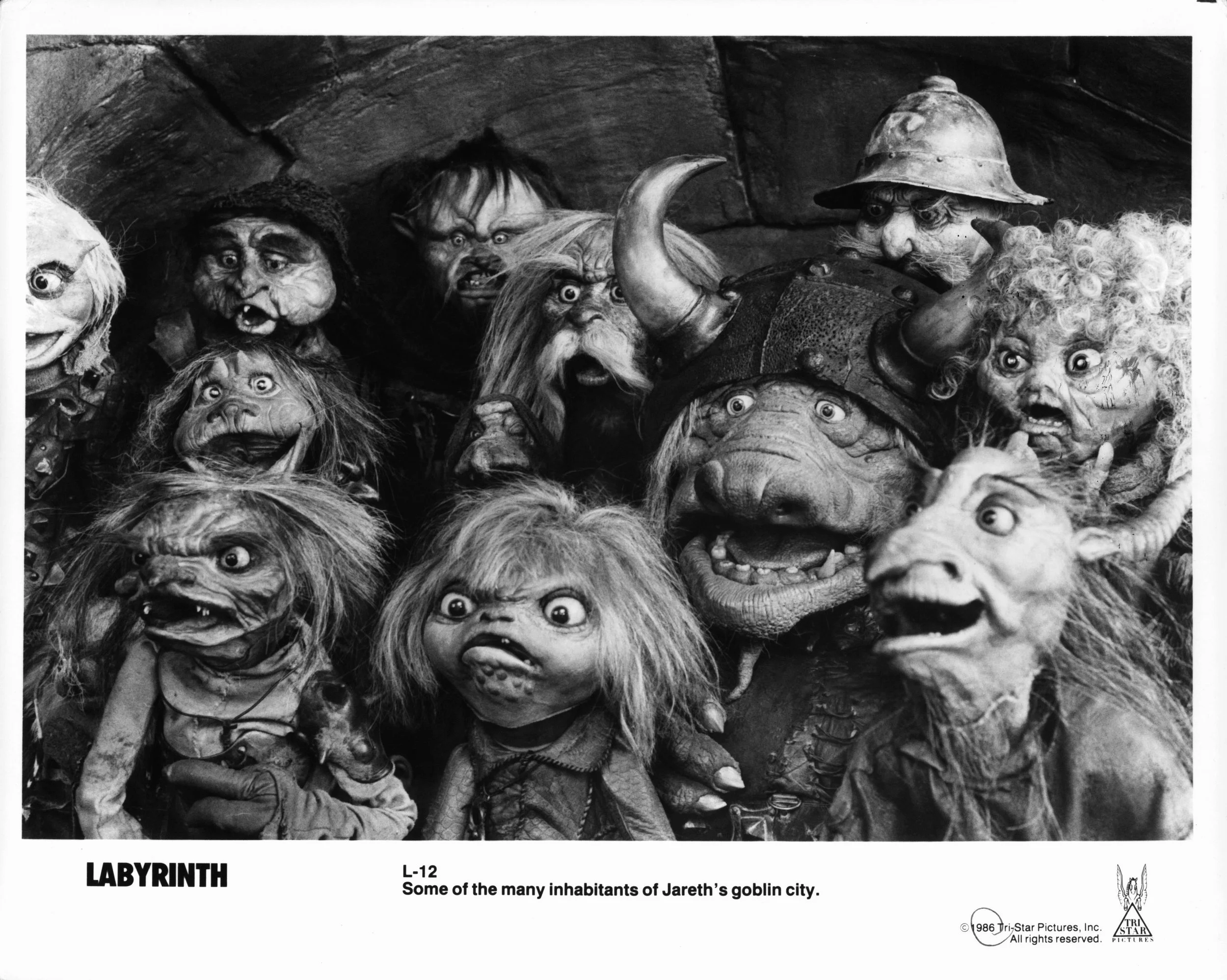
The initial concept that would see itself brought to fruition was a fairy tale-like journey through a maze.
The story would have influences from the classics like Grimm fairy tales, European folklore, and coming of age myths.
It would also explore Jungian psychology and themes.
In 1983, Monty Python’s Terry Jones was brought in to write the screenplay.
This infused the story with British humor and wordplay.
End result? Kids and adults would find this funny.
On multiple occasions I found myself catching things that I never did as a kid, and I saw this movie a lot.
During this period of development, George Lucas was also brought in to serve the role of executive producer.
He helped shape the narrative structure and soften some of the darker elements to help guide the film towards a PG audience.
The final piece of the puzzle was for the role of Jareth the Goblin King. For this, Jim Henson would need a rockstar.
Who better than David Bowie?
He would check the boxes that Jim Henson was looking for.
Otherworldly?
Check.
Seductive?
Check.
Dangerous?
Check
Playful?
…you get the idea.
Once Bowie was in, he rewrote lyrics to some of the songs to match the new energy that he brought to the character.
He also brought an adult tension into the film, which helped shape and better communicate the film’s themes.
In June 1986, the project was complete and Jim Henson’s Labyrinth was released to the public.
And the reactions were, mixed.
The film did not recoup its production costs, and was a commercial failure.
This was especially difficult for Jim Henson after the underwhelming performance for The Dark Crystal 4 years earlier.
The critics and movie goers alike had the same confusion.
Who is this movie for?
Some felt it was too dark for kids.
Others felt it was too whimsical for adults.
While Henson’s puppetry and practical effects were praised, along with the visual design of most everything, the framing at the time was always one that was confused with the end result.
So why talk about this at all?
Well, things change. Times change, reception towards art changes.
Over the years, there is a reason why audiences have begin to discovery this hidden gem still.
It’s because it was ahead of its time.
Now fantasy is commonplace and more nuanced and complex takes on humanity and psychology are expected.
Back when Labyrinth was released?
Audiences wanted something straight forward. Something that looked more outward and not so much inward.
This isn’t necessarily a bad thing, it is just part of growing up.
Which brings us full circle back to the beginning. The idea that this movie was about coming of age.
It is about the strangeness of life as you get older, and the discomfort you feel with what you feel, think, and see.
Watching this as an adult and seeing my children watching the movie through the lens of their own experience was special.
As with life, there are things you just don’t understand when you are younger.
Jim Henson reflected on Labyrinth later in his years and concluded that audiences weren’t ready for the film.
In a sense he is right.
Now that it is more well known, you can find plenty of people online analyzing the movies themes and details.
Some things need time.
Some things are ahead of their time.
And that’s okay.
Be authentically you, and go make what you need to make.
Let others catch up with you later.
2: Creative Prompts From Us (ex. Write a short story, a poem, a song, or draw a quick illustration of these! Let your imagination run free.)
I. What do you want to see made that you don’t see made?
II. What can you do to bring it to life on your own?
3: Quotes From Jim Henson
I. “Children use fantasy to master their fears. Adults use it to forget theirs.”
II. “Puppets can say things humans can’t.”
III. “The labyrinth is not a place. It’s a process.”
Thank you so much for reading!